
Why Chinese Game Studios Are Outpacing Japan: A Player’s Journey into Development Speed
Chinese studios like miHoYo outpace Japan's developers, but their relentless speed may rely on crunch and looser labor laws.
As I sit in front of my gaming setup in 2026, it’s impossible to ignore how the global gaming landscape has shifted. Every time I boot up Genshin Impact, Honkai: Star Rail, or any of the other visually stunning titles emerging from China, I feel a mix of awe and curiosity. How did studios like miHoYo manage to release content at such a relentless pace, with a level of polish that captivates tens of millions of players worldwide? Recently, I stumbled upon some reflections from Shuhei Yoshida, the former head of Sony Interactive Entertainment Worldwide Studios, and his words resonated deeply with my own observations. His candid take on Japanese developers struggling to keep up with Chinese studios doesn’t just speak about business – it speaks to the soul of modern gaming culture.
Yoshida’s commentary, originally shared with 4Gamer, painted a vivid picture of two different worlds. On one side, you have the legendary Japanese game industry, home to meticulous craftsmanship and narrative masterpieces. On the other, China’s rising powerhouses, driven by a development speed that Yoshida described as “amazing” and a personnel strategy that allows rapid restructuring. When I read that miHoYo representatives told him how difficult it would be for Japanese developers to replicate their model, I could almost see the chasm — not just in technology, but in labor philosophy. Yoshida hinted at “legal problems” as a barrier, suggesting that stricter worker protections in Japan prevent studios from scaling up teams to the massive sizes or working hours common in some Chinese environments. As a player, this immediately tugged at my conscience: the games I love might be built on a foundation of uncomfortable trade-offs.
I can’t help but think about how different the term “crunch” feels depending on where you look. In the Western gaming sphere, we’ve seen high-profile activism against overtime, with developers unionizing and publishers facing pressure to improve conditions. Yet, paradoxically, the same publishers often outsource asset creation or entire sections of games to countries where labor is cheaper and expectations of work hours differ. Yoshida’s point echoes this global imbalance: Chinese studios appear to have created an environment where hiring hundreds of artists and engineers to push out updates every six weeks isn’t just feasible – it’s the norm. The legal fuzziness he mentions might be less about exploitation and more about a cultural and regulatory framework that simply permits a different work rhythm. But for an outsider like me, the line between efficiency and overwork can look terrifyingly thin.
Of course, there’s another side to the story, and it’s one that often gets lost in translation. While reports of crunch in Western publishers occasionally surface with alarming detail, the internal realities of miHoYo and similar studios remain somewhat opaque. We’ve all heard the rosy anecdotes: employees receiving free PS5s and luxury gifts during festivals, sleek office tours showing nap rooms and gaming lounges, and even stock options that could turn junior staff into millionaires overnight. I see these snippets shared on social media and they color my perception. Are these studios genuinely wonderful places to work, rewarding passion with wealth, or is the generosity a carefully curated facade? I don’t have a definitive answer, but the duality itself is fascinating. What’s clear is that from my player’s chair, the output speaks volumes — the rapid iteration on game mechanics, the cascade of character models, and the seamless blending of live service and single-player depth feel almost superhuman.
The effect on Japanese development, according to Yoshida, is palpable. He noted that while Korean and other Chinese developers are now releasing “miHoYo-like games”, miHoYo itself seems to be stepping ahead, exploring new territory. I’ve witnessed this firsthand. Last month, I tried a game that reportedly originated from a Chinese studio’s attempt to fuse Genshin Impact’s gacha charm with a full-fledged MMO economy, complete with PvP arenas and AI-driven NPCs. It felt like an evolution so fast that my muscle memory from last year’s titles was already obsolete. Japanese studios, with their smaller, more rigid teams, might simply lack the manpower to compete in this live-service arms race — not because of any creative deficiency, but because the legal frameworks Yoshida alludes to cap the raw hours a developer can contribute. When you’re playing a game that demands content every patch, raw time becomes a resource just as precious as artistic vision.
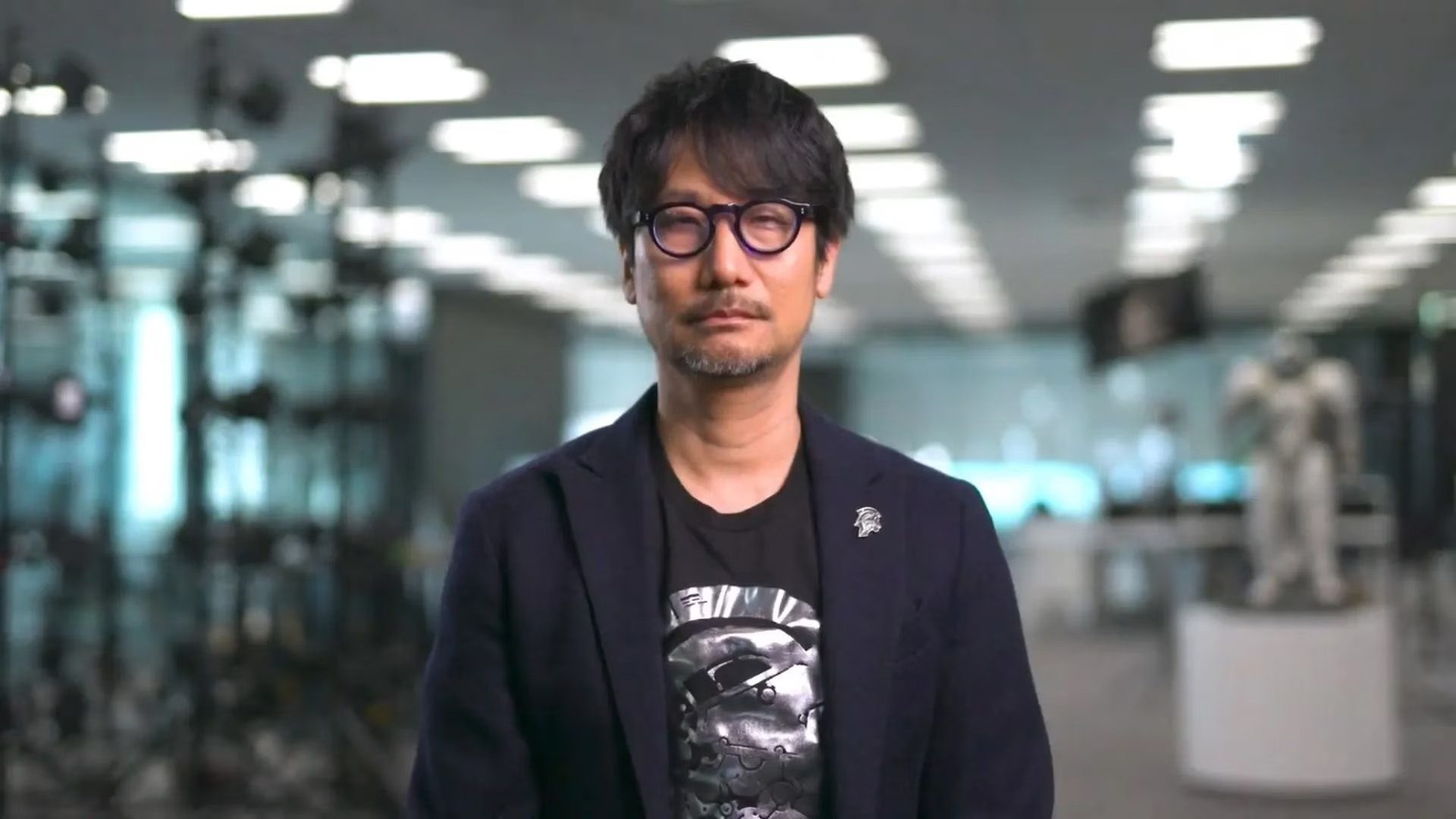
Yet, part of me clings to the hope that speed isn’t the only metric that matters. I think of the Kojima Productions logo flash on screen, and suddenly I’m transported into worlds that feel authorial, where every frame is deliberate. Yoshida himself previously highlighted Hideo Kojima’s ability to craft experiences that other AAA blockbusters can’t replicate. Japanese games often trade on that uniqueness — the patience to polish a boss fight until it feels like a dance, or to weave a story that stays with you for years. While Chinese studios excel at volume and technological aggression, I wonder if the future belongs to those who can blend both philosophies. Maybe the days of a single studio working in isolation are over, and the next generation of hits will emerge from cross-continental collaboration where Chinese scale meets Japanese artistry.
For now, in 2026, I’m holding my controller a bit more thoughtfully. Every dazzling update I download contains invisible history — a tapestry of labor laws, cultural expectations, and economic incentives. I don’t want to demonize any country’s approach, but I do want to stay aware. When I explore a new miHoYo region at dawn, with the soundtrack swelling and my friends chatting over Discord, I’ll enjoy the moment. But I’ll also appreciate the slower-burning masterpieces from Japan, knowing that both exist because of — and sometimes despite — the very human systems behind them. That awareness, perhaps, is what a responsible player in this era should carry.
Comments (0)