
Ark: Survival Ascended Performance Woes Signal Troubled Future for Ark 2 on Consoles in 2026
Ark: Survival Ascended's performance analysis reveals alarming Xbox Series S struggles, casting doubt on Ark 2's Unreal Engine 5 future.
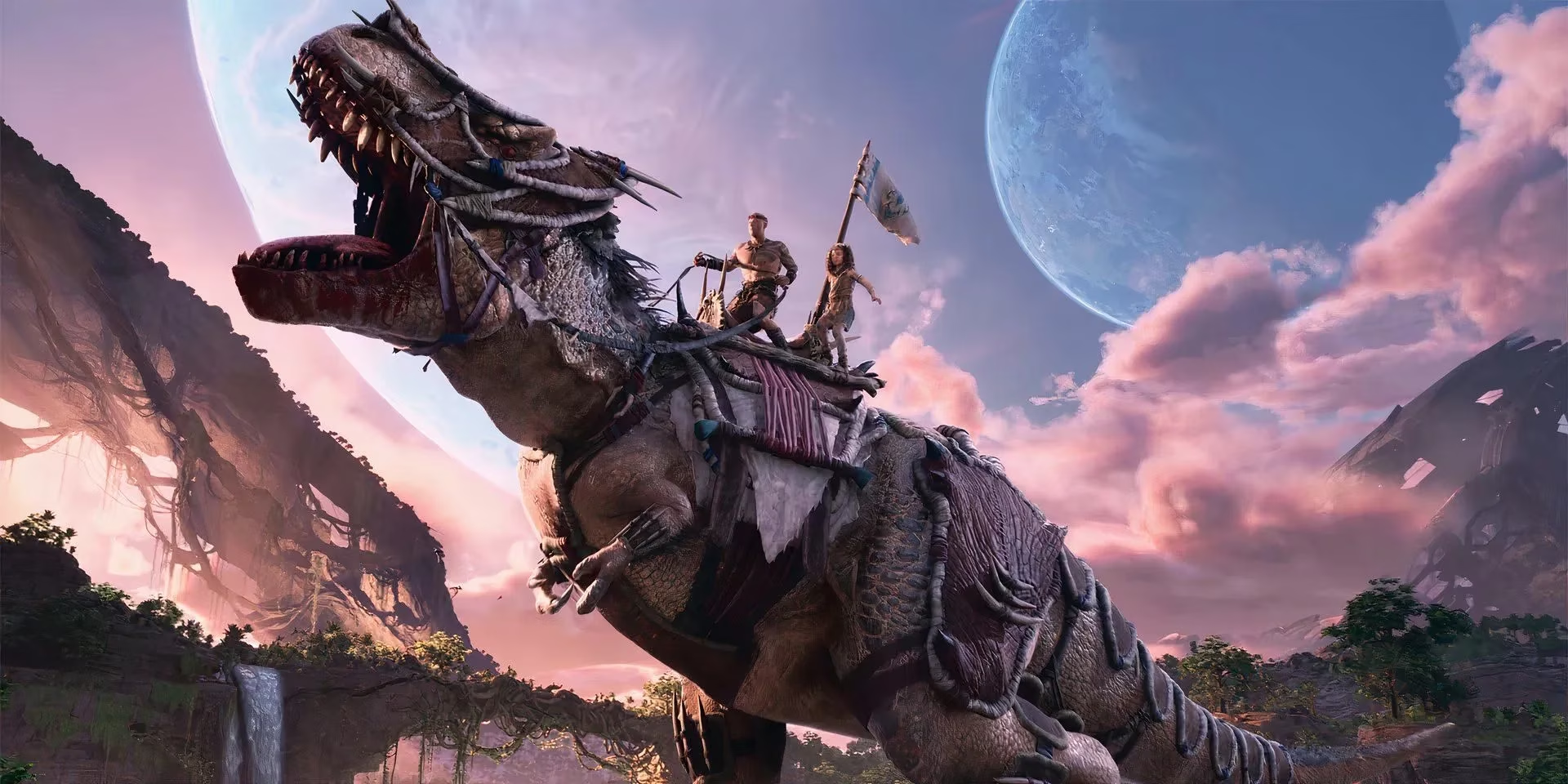
As a console gamer who's been following the evolution of the Ark franchise, the recent performance analysis of Ark: Survival Ascended across different platforms has been both illuminating and deeply concerning. In 2026, we're looking at a gaming landscape where next-gen promises should be delivering, yet here we have a re-released title struggling to maintain basic performance standards, particularly on Microsoft's budget-friendly Xbox Series S. The implications stretch far beyond this single title, casting a long shadow over the highly anticipated Ark 2, which shares the same Unreal Engine 5 foundation. What we're witnessing isn't just optimization issues—it's a fundamental mismatch between ambitious game design and hardware capabilities that could define the console gaming experience for years to come.
🎮 Xbox Series S: The Compromise Console Struggles
Digital Foundry's recent technical deep-dive revealed just how much the Xbox Series S has to sacrifice to run Ark: Survival Ascended. Starting with the default settings, the console is forced to strip back major graphical features that are standard on PS5, Series X, and PC versions. The world textures appear far less detailed, creating a strangely smoothed-over aesthetic that feels like viewing a prehistoric landscape through a fogged-up window. Swimming animations lose their splashes and wakes—a small detail that significantly impacts immersion, making the aquatic experience feel as lifeless as a museum diorama.

The compromises extend beyond static visuals. Physics-based interactions—specifically, foliage that should react to player movement—are completely absent on Series S. Grass and bushes remain perfectly still as players pass through them, breaking the illusion of a living, breathing world. This removal of environmental reactivity makes the game world feel static and disconnected, like exploring a beautifully painted but utterly frozen diorama. For a game whose entire premise revolves around survival in a dynamic ecosystem, these cuts fundamentally undermine the experience.
📊 Performance Metrics: The Numbers Don't Lie
Even with these significant graphical downgrades, the Xbox Series S struggles to deliver acceptable performance. Here's how the consoles compare in Ark: Survival Ascended:
| Console | Target Resolution | Typical Resolution | Average FPS | Lowest Observed FPS |
|---|---|---|---|---|
| Xbox Series S | 900p | 450p (Dynamic) | ~45 FPS | 14 FPS |
| Xbox Series X | 1440p-4K | Dynamic Scaling | 50-60 FPS | 30 FPS |
| PS5 | 1440p-4K | Dynamic Scaling | 50-60 FPS | 30 FPS |
| High-End PC | 4K Native | 4K Native | 60+ FPS | 45 FPS |
The Series S frequently operates at what Digital Foundry measured as approximately 450p resolution—a figure that feels archaic in 2026. Even at this reduced resolution, the game rarely maintains 60 FPS, typically hovering around 45 FPS with frequent drops. During demanding scenes with environmental effects like rain or complex lighting transitions, frame rates can plummet to as low as 14 FPS, creating a slideshow-like experience that's practically unplayable for competitive or cooperative online scenarios.
🌧️ Environmental Factors: The Performance Killers
Certain in-game conditions act as performance kryptonite for the Series S:
-
Rain effects cause immediate and severe frame rate drops
-
Day-night transitions with dynamic lighting overwhelm the system
-
Dense vegetation areas strain the already compromised rendering pipeline
-
Multiplayer scenarios with multiple players and creatures create unpredictable performance cliffs
These issues aren't merely cosmetic—they directly impact gameplay. In a survival game where timing combat against dinosaurs or navigating treacherous terrain can mean life or death, inconsistent performance becomes more than an annoyance; it becomes a gameplay disadvantage.
🖥️ The Broader Console Landscape: No One Escapes Unscathed
While the Xbox Series S emerges as the most compromised platform, it's crucial to recognize that all consoles struggle with Ark: Survival Ascended. Both the PlayStation 5 and Xbox Series X, while offering markedly better performance than their budget sibling, frequently fail to maintain a stable 60 FPS. Their dynamic resolution scaling helps, but they too sacrifice visual features available on high-end PC configurations. The performance gap between consoles and capable gaming PCs in 2026 feels increasingly like comparing a sturdy rowboat to a speedboat—both can get you across the water, but the experience differs dramatically.

🔮 Ark 2: The Engine of Concern
The most alarming revelation from this performance analysis is that Ark 2 will run on the same Unreal Engine 5 foundation as Survival Ascended. Studio Wildcard has confirmed this technical continuity, meaning the optimization challenges plaguing the current title will almost certainly carry forward. Given the studio's historical reputation for releasing technically demanding games that require substantial post-launch optimization, console players have legitimate reasons for concern.
Consider these parallel developments:
-
Shared Technical DNA: Both games utilize UE5's Nanite virtualized geometry and Lumen global illumination systems
-
Similar Scope: Ark 2 promises even larger, more detailed open worlds with complex ecosystems
-
Cross-Platform Mandate: The game must run across the same console spectrum as its predecessor
-
Performance Expectations: Players in 2026 expect stable 60 FPS as standard, not exceptional
The situation reminds me of trying to run modern simulation software on hardware designed for basic word processing—the fundamental mismatch creates inevitable performance compromises. For Ark 2, this could mean:
-
Series S: Even more aggressive graphical cutbacks than Survival Ascended
-
Series X/PS5: Potential resolution or frame rate compromises to maintain visual parity
-
All Consoles: Possible delayed feature implementation compared to PC version
💡 Potential Solutions and Developer Responsibility
While the technical challenges are significant, they're not insurmountable. Studio Wildcard could employ several strategies to improve Ark 2's console performance:
Technical Optimization Approaches:
-
More aggressive LOD (Level of Detail) systems for distant objects
-
Dynamic resolution scaling with wider adjustment ranges
-
Optional performance modes that prioritize frame rate over visual fidelity
-
Staggered feature releases that allow optimization time between updates
Design Considerations:
-
World design that accounts for console limitations from the outset
-
Scalable multiplayer systems that adjust complexity based on hardware
-
Modular graphical settings that players can customize beyond simple presets
However, these solutions require development time and resources that Studio Wildcard has historically allocated elsewhere. The question becomes whether the studio will prioritize optimization for Ark 2 or continue its pattern of releasing technically ambitious but poorly optimized titles.
🦖 The Dinosaur in the Room: What This Means for Console Gaming
As we look toward Ark 2's eventual release, the Survival Ascended performance analysis serves as both warning and opportunity. The warning is clear: without significant optimization efforts, console players may receive a compromised version of what could otherwise be a groundbreaking survival experience. The opportunity lies in Studio Wildcard's ability to learn from these challenges and deliver a product that respects the limitations of console hardware while still pushing creative boundaries.
For Xbox Series S owners specifically, the situation feels particularly precarious. The console's value proposition has always been about accessibility, but when that accessibility comes at the cost of fundamental gameplay integrity, the equation changes. Playing Ark: Survival Ascended on Series S feels like watching an epic film through a keyhole—you get glimpses of the grandeur, but never the full experience.
🎯 Looking Ahead: Realistic Expectations for Ark 2
Based on the current evidence, console players should temper their expectations for Ark 2's technical performance. While hoping for miracles is natural, the more realistic outlook includes:
-
Likely: Series S version with significant visual compromises
-
Probable: Performance inconsistencies across all consoles
-
Possible: Staggered feature parity between console and PC versions
-
Unlikely: Day-one optimization matching high-end PC experience
The gaming industry in 2026 continues grappling with cross-platform development challenges, and Ark 2 represents a particularly difficult case study. When a game's design philosophy emphasizes visual grandeur and systemic complexity, reconciling that vision with hardware limitations becomes an engineering puzzle of the highest order.
🔄 The Community's Role: Feedback and Patience
As players, our role in this unfolding story involves providing constructive feedback while practicing measured patience. Performance analysis like Digital Foundry's serves the crucial function of holding developers accountable while educating consumers about technical realities. In an era where marketing often overshadows technical limitations, this transparency benefits everyone in the gaming ecosystem.
What we're witnessing with Ark: Survival Ascended isn't just about one game's performance—it's about the evolving relationship between game design ambition and hardware capabilities. As console generations progress and player expectations rise, developers face increasing pressure to deliver experiences that feel next-gen across an expanding spectrum of hardware. How Studio Wildcard addresses these challenges with Ark 2 will not only determine that game's success but also contribute to the ongoing conversation about what constitutes acceptable performance in modern console gaming.
In the meantime, console players interested in the Ark universe might approach Survival Ascended with cautious optimism and Ark 2 with tempered expectations. The promise is undoubtedly exciting, but the path to realizing that promise on current console hardware appears more treacherous than the game's prehistoric landscapes.
In-depth reporting is featured on Game Developer, and it helps frame why a UE5-heavy project like Ark can falter on fixed consoles: ambitious systems (global illumination, virtualized geometry, dense simulation) often collide with real-world CPU/GPU/memory budgets, forcing developers into hard trade-offs like cutting reactive foliage, shrinking effect complexity (rain, particles), and leaning on aggressive dynamic resolution to preserve playability—choices that directly shape how Ark: Survival Ascended (and potentially Ark 2) will feel on hardware like the Xbox Series S.
Comments (0)